
In a world of Reels, carousels, and split-second decisions, we forget – copy is more than filler between pretty images and CTAs. If you want your message to land, the words matter. Some hold. Some get swiped away.
The right words don’t feel like someone informing you—or, worse, patronizing you. They feel like someone finding you. The reader isn’t impressed by them; they recognize themselves.
When you feel recognized, you lean in. You join in, take action, or share it—because that’s today’s way of saying, “Yes. This is me. I agree.”
And the wrong words? Well, that’s why we have thumbs. The perfect evolution tool for swiping away.
As a freelance copywriter, I love when I can help businesses craft content that makes their people feel seen… And earn the yes. These are four tried-and-tested copywriting techniques I use in my own work—and yes, you’re absolutely welcome to steal them.
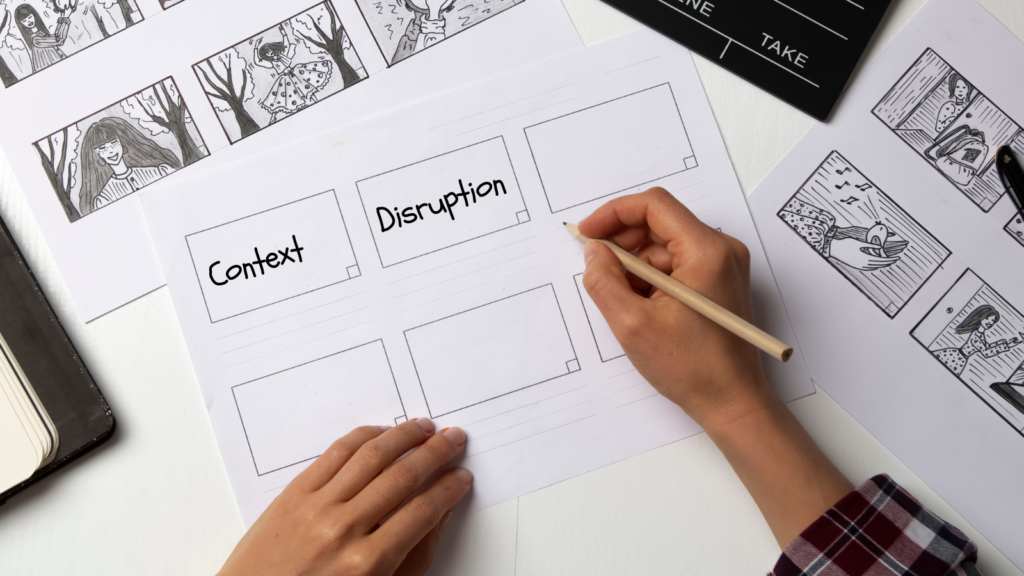
1. Context – Disruption
Every great story lives between context and disruption. Homer knew it. Hemingway used it. Apple built a brand on it: show what is status quo, then break it—expose what’s missing, what’s frustrating, what’s outdated—so the audience feels the need for what comes next.
Context says, “Here’s what’s happening.”
Disruption says, “Yeah… but now there’s a problem.”
The easiest way to audit your copy is simple:
If you keep writing “then,” your story goes flat. Upgrade it for “but” and “that’s why”
“This happened, but… this went wrong.”
“This happened, that’s why … we had to do this next.”
That’s when people are paying attention — disruption pulls a loose thread, and your brain needs to see where it goes.
Checklist
• Outline your story in points.
• Add a disruption within the first paragraph.
• Between every point, replace “and then” with “but” or “that’s why”.
Read your text out loud. If it reads like “and then… and then…,” that thumb is already itching to swipe.
Extra tip: Tone — Talk with me, not at me
The best storytellers feel like they know you. They speak to you, narrating part of your story. So stop writing like you’re addressing “the internet.” Write like you’re sending a letter to one person.
2. Sentence Rhythm
The dreaded rhythm of bad copy:
Same length. Same pace. Same vibe.
Fix it. Mix it.
Short sentences.
Medium ones.
And then—once in a while—hit them with a longer sentence that builds, pulls the reader forward, and feels like a thought unfolding in real time.
What it is: When sentences vary in length and pacing – the mind stays engaged.
Why it works: Predictable rhythm feels boring. Variety feels like a promise: something new is around the corner.
3. Start From the End
Your last line should stand on its own—like a mirror for your reader.
Then make the next step match what they just saw.
What it is: Figure out the final line/idea first, then build backward.
Why it works: You know where you’re taking people, so every line earns the next.
Checklist
• Write your last line first.
• Treat the ending as non-negotiable: the wording can evolve, but the point stays.
• Write the first sentence second.
• Test the first sentence: If someone hears the first line with no context, do they still know what the text is about?
• Fill the middle with “but”/”and that’s why” rhythm.
• Make the CTA match the ending: one clear action that fits what they just nodded along to.
4. Your Angle
This is very important. It definitely doesn’t belong at the end. But hear me out: it’s #4 only because it’s so important it almost feels obvious.
What it is: Same topic, different angle. Your angle is your differentiation.
Once upon a time, my literature professor welcomed us students with a lecture that made me…dislike him. He told us: “There are no new ideas. If 2% of what you write is you—you are a genius.”
I was 18 and full of myself, but many years later, but I’m here to tell you: he was right.
A “new topic” is rare, unicorn rare. But a “new angle” is always available—and it starts with you, so you already have it.
So instead of asking, “What should I post?”
Ask, “What’s my angle?”
Checklist
• Think about the most obvious angles of your story. Write a list. Don’t use them. Do the opposite.
• State your angle in the hook (so people know why to keep reading).
• Take it to one point that only your angle would include.
No brainer test: If your text sounds like the popular opinion—or it could be swapped with 50 others—your angle is too generic.
The “Yes”
Making people feel seen isn’t easy—and it’s only step one. Recognition alone doesn’t convert; it simply holds attention long enough to earn a chance at “yes.”
The “yes” is what you place right after that moment:
- a clear next step
- a simple choice
- one action that matches what they’ve already been nodding along to
People like to check their own reflection. When your words feel like a mirror, the reader leans in. And when your offer feels like the natural next step, they say yes.
The final filter
So, the recipe is: add context, introduce disruption, vary the rhythm, choose an ending, and commit to an angle. Then make the next step logical.
Next time, before you hit publish, be honest with yourself:
Does this sound like one person speaking to another? And is the next step easy to take?
That’s how good content earns the yes.